
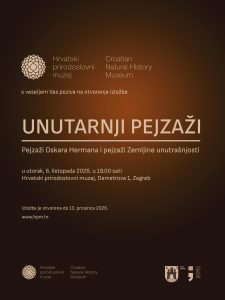
INNER LANDSCAPES
Oskar Herman’s Landscapes and the Landscapes of the Earth’s Interior
What is a landscape? Is it simply what we see when we pause and look at the natural world around us – a hill, a forest, the sky, a river or a rock? Or can a landscape also be something hidden: a space of emotions, memories and thoughts, or even the world of geological processes taking place deep beneath the Earth’s surface?
The exhibition Inner Landscapes at the Croatian Natural History Museum begins with precisely this question, opening a dialogue between art and the natural sciences. It brings together the late landscapes of Oskar Herman, created during the 1960s and early 1970s, with minerals and rocks from the Mineralogical and Petrographic Collection of the Croatian Natural History Museum.
In Herman’s late works, nature gradually moves away from the depiction of a recognisable landscape. Trees, hills, sky and earth are no longer merely elements of a real place, but become carriers of emotions, memories, thoughts and inner states. The landscape ceases to be simply what the artist sees and becomes what he experiences through it – a space of introspection, an inner landscape.
The second part of the exhibition takes us into an entirely different kind of interior – deep into the Earth. Minerals and rocks are not merely beautiful or intriguing natural forms, but material records of processes that have shaped our planet over immense periods of time. Their structure, composition and form bear witness to the forces, transformations and passage of time hidden beneath the surface.
An unexpected yet powerful connection thus emerges between Herman’s paintings and geological specimens: one leads us towards the inner world of the human being, the other towards the interior of the Earth. In both cases, what we see is the result of processes that themselves remain hidden from view.
Inner Landscapes therefore offers no single definition of landscape. Instead, it invites visitors to move from surface to depth, from the visible to the hidden, from the outer world to the inner one.
What can a landscape become when we stop looking only at the surface?
Authors
Jasminka Poklečki